Quick Answer: The speed controller is the most commonly blamed part in electric golf cart troubleshooting, and it is also the most commonly misdiagnosed one. True controller failure has specific symptoms: no cart movement despite a healthy solenoid click and confirmed battery voltage, erratic speed output that does not match pedal input, error codes on diagnostic-capable platforms, or heat shutdown after short runtimes. Before any controller is replaced, the battery pack, solenoid, throttle sensor, and wiring must all be confirmed healthy. Resort Life Carts in Madera performs complete electrical system diagnostics before recommending controller replacement. See our battery service and EZ-GO TXT troubleshooting guide for related diagnosis paths.
The speed controller gets blamed for a lot of things it did not cause. When a golf cart behaves oddly, sluggishly, or not at all, the controller is often the first part an owner decides to replace. That instinct costs a lot of people money unnecessarily. The controller is a durable component. It rarely fails on its own without some upstream problem pushing it past its limits. Understanding what a true controller failure looks like, and what it does not look like, is the starting point for getting this diagnosis right.
What the Speed Controller Actually Does
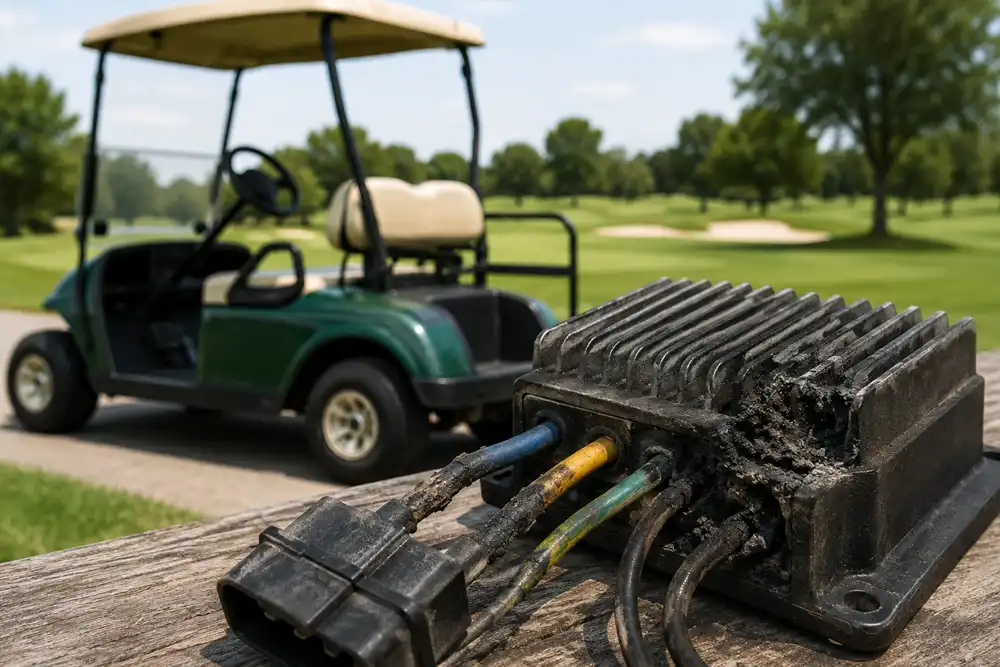
The speed controller manages how much electrical current flows from the battery pack to the motor. When you press the accelerator pedal, the throttle position sensor sends a signal to the controller. The controller reads that signal and adjusts output current to the motor proportionally. Press the pedal halfway, get roughly half power. Press it fully, get full power. The controller does this dozens of times per second by rapidly switching current on and off through internal transistors called MOSFETs.
This process generates heat. Controllers have heat sinks and thermal protection built in. When a controller runs too hot, it reduces output or shuts down. When the MOSFETs wear out or fail, the switching process breaks down and the cart behaves unpredictably. That is the core of what a failing controller looks and feels like.
Warning Signs That Point to the Controller
Certain symptoms, when they occur together and after other components have been ruled out, point clearly to the controller. Erratic speed is the most telling. A cart that surges to full speed from a dead stop without progressive acceleration, or that responds inconsistently to the same pedal position, is showing a controller that can no longer modulate current smoothly. This happens when MOSFETs begin failing and current flow becomes uncontrolled.
No movement despite a healthy solenoid click is another strong indicator. When you press the pedal and hear the solenoid engage but the cart does not move, the battery pack voltage is arriving at the controller but the controller is not passing it to the motor. That can be a wiring fault, a motor fault, or a controller fault. Ruling out the first two leaves the controller.
Heat-related shutdown after a short runtime is a third sign. We covered this pattern in detail in our article on a golf cart that stops when hot. When the controller is the specific cause of the heat shutdown, the cart typically runs for 10 to 20 minutes and then cuts off cleanly, restarting normally after cooling. If the shutdown happens in less than five minutes, the controller’s thermal protection circuit may itself be damaged and triggering prematurely.
What Is Not a Controller Problem
A cart that will not move at all with no solenoid click is not a controller problem. The controller never received battery voltage in the first place. That is a solenoid, wiring, or key switch issue. We cover the no-click scenario in our article on a cart that starts and then dies.
A cart that moves slowly but consistently, with no erratic behavior, is almost always a battery problem. Slow, consistent, low-power output is what a battery pack under heavy voltage sag looks like from the driver’s seat. The controller is doing its job correctly with the voltage available to it. Replacing the controller in this situation does nothing. Our article on a golf cart that struggles uphill goes deeper on battery voltage sag under load.
Technician Diagnostic Standard
“Never replace a controller before confirming battery pack health, solenoid operation, throttle sensor output, and wiring integrity. Controllers fail last, not first. They fail because something else failed first and pushed them past their design limits.”
Standard diagnostic protocol used by Resort Life Carts service technicians and consistent with best practices across the professional golf cart repair community. Skipping this sequence leads to unnecessary controller replacements that do not fix the original problem.
Confirming the Controller Is the Actual Problem
The correct diagnostic sequence before condemning a controller starts with battery pack load testing under real operating conditions. If the pack voltage holds up under load, the battery pack is ruled out. Next, verify solenoid operation: it should click in cleanly and hold closed while the pedal is pressed. Then test throttle position sensor output across the full pedal range. It should rise smoothly and reach the expected maximum voltage.
If all three of those check out and the cart still behaves abnormally, the controller is the remaining suspect. On platforms with diagnostic capability, including many newer EZGO and Club Car models, a handheld programmer or Bluetooth diagnostic tool can pull fault codes directly from the controller. Fault codes narrow the diagnosis significantly and can sometimes reveal whether the controller has an internal fault or is responding to a bad signal from another component.
Testing the controller directly
With the battery pack confirmed healthy and connected, measure the voltage at the controller’s B+ and B- terminals. You should see full pack voltage there when the solenoid is engaged. Then measure at the motor output terminals while the pedal is pressed. If full voltage is arriving at the controller input but little or no voltage is reaching the motor output, the controller is not switching. That is a failed controller.
Repair vs. Replacement
Controller repair is possible in some cases. A shop with electronics capability can replace failed MOSFETs, capacitors, or other discrete components. This is most cost-effective on high-end or hard-to-source controllers where a replacement costs several hundred dollars. For most standard 48-volt controllers on common platforms, the labor cost of repair approaches or exceeds the cost of a quality replacement, and a new controller comes with a warranty.
If you are replacing the controller on an older cart, this is also the moment to consider whether a performance upgrade makes sense. A higher-amperage controller will give the motor more current headroom, which improves acceleration and hill climbing. The motor and battery pack must be capable of handling the additional current for the upgrade to work properly. Pairing a high-amp controller with our lithium battery upgrade is one of the most effective combinations for improving overall cart performance, since a lithium pack can sustain high current draw without the voltage sag that limits a lead-acid pack.
For a broader view of what regular service catches before controller stress becomes controller failure, our electric golf cart maintenance guide covers the inspection points that protect electrical components over the long term.
Frequently Asked Questions
How do I know if my golf cart speed controller is failing?
The clearest signs are erratic speed that does not match pedal position, no movement despite a healthy solenoid click and confirmed battery voltage, or heat shutdown after a short runtime. These symptoms should only point to the controller after the battery pack, solenoid, and throttle sensor have been confirmed as healthy.
Can a bad battery damage the speed controller?
Yes. A battery pack with severely degraded cells can produce voltage spikes during charging that exceed the controller’s input tolerance. Over time, repeated exposure degrades the controller’s internal components. Addressing battery health promptly matters beyond performance — a failing pack can take the controller with it.
Should I repair or replace a failing golf cart controller?
Repair is sometimes possible when a single component such as a capacitor or MOSFET has failed. However, repair requires specialized equipment, and on older controllers the repair cost can approach the cost of a quality replacement. For regularly used carts, a new or professionally rebuilt controller is usually the more reliable choice.
Does upgrading to a higher-amp controller improve golf cart performance?
Yes, within limits. A higher-amperage controller allows more current to flow to the motor, which increases torque and acceleration. The motor and battery pack must be capable of handling the additional current for the upgrade to be safe and effective. Installing a high-amp controller on an aging battery pack will not produce the expected results.
Suspect your controller is failing? Schedule a full electrical diagnostic with Resort Life Carts in Madera, CA. We confirm the root cause before recommending any controller replacement. Pickup and delivery available across the Central Valley.