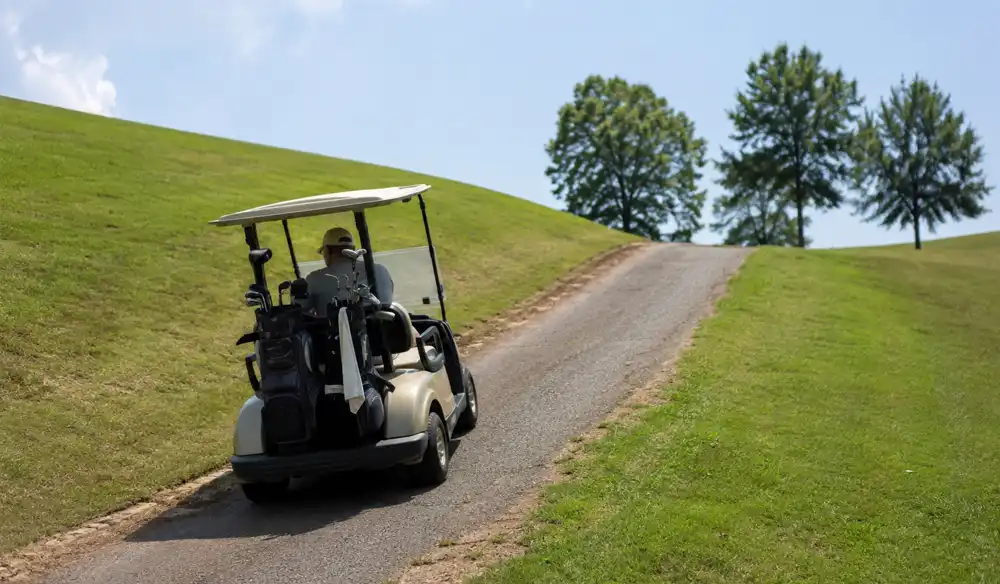
Quick Answer: A golf cart that loses power or stalls on hills is almost always dealing with battery voltage sag under load, a motor that’s working beyond its healthy operating range, or mechanical resistance in the drivetrain adding to the strain. Batteries that test fine at rest can sag well below the controller’s minimum threshold the moment they’re asked to push the cart uphill with passengers — and that sag is invisible without a proper load test. Resort Life Carts in Madera, California diagnoses uphill performance loss through real-condition load testing, motor inspection, and drivetrain checks. See our battery service and brakes and suspension service for related issues.
A golf cart that bogs down, slows dramatically, or cuts out entirely on grades is one of the most common performance complaints we see at the shop, and one of the most commonly misdiagnosed by owners attempting to fix it themselves. The instinct is usually to blame the motor. In reality, the motor is usually the last thing to fail. The far more common culprit is what’s feeding the motor: the battery pack under load.
Battery Load: The Number One Hidden Cause
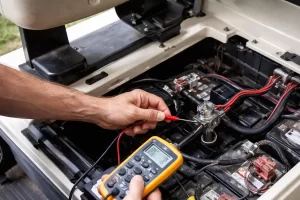
Going uphill is the hardest thing you ask your golf cart to do. The motor is pulling maximum or near-maximum current, passengers add weight, and there’s no regenerative assist to ease the demand. For a healthy battery pack, this is a manageable situation. For a pack with aging cells, increasing internal resistance, or even a single weak battery in the series string, climbing a grade triggers something called voltage sag, the pack voltage drops under load, and the controller responds by reducing power output or shutting down entirely to protect the motor and electronics.
Here’s the part that catches most owners off guard: the same batteries that test at 50.9 volts sitting in your garage can sag to 44 or 45 volts the moment the motor pulls hard. At that voltage, the controller doesn’t have enough headroom to maintain full motor output, and the cart slows noticeably. If the pack is more degraded, it can drop low enough to trigger a complete cutoff, leaving you stranded mid-hill.
“Battery voltage drop under load is the number one cause of uphill failure, and it’s completely invisible if you’re only testing resting voltage. You have to check voltage while the cart is under actual driving load to see what’s really happening.”
Consistently validated across EV and golf cart owner communities on Reddit’s r/golfcarts and r/electricvehicles, and confirmed by our technicians: a cart that shows acceptable resting voltage can still be failing under load. Resting voltage tests alone miss this entirely.
Motor Strain: When the Motor Itself Is the Problem
Once battery health is ruled out, the motor becomes the next candidate. DC series-wound motors, the type found in most older golf carts — can develop worn brushes, degraded brush springs, and commutator wear over time. When the brushes aren’t making clean contact, the motor’s ability to convert electrical energy to mechanical torque drops. The result is a motor that draws more current to produce the same output, which stresses the batteries and controller further and creates the exact hill-climbing weakness you’re experiencing.
Signs that the motor is struggling beyond just the battery include unusual heat coming from the motor compartment, a grinding or buzzing noise under heavy load, and a distinct smell of electrical burning after climbs. Motor brushes on most DC motors are a serviceable wear item, and replacing them can restore full performance if the commutator itself isn’t worn beyond spec.
If your cart is a model that has been consistently difficult to troubleshoot, our guide on motor runs but cart won’t move addresses related drivetrain scenarios that often overlap with hill performance issues.
Mechanical Drag: The Often Overlooked Third Factor
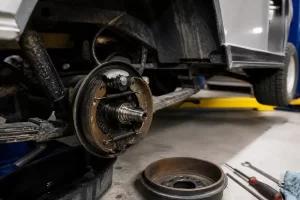
Even a cart with healthy batteries and a good motor will underperform on hills if there’s mechanical drag adding to the load. Dragging brakes are one of the most frequent culprits — a brake shoe or drum that isn’t fully releasing creates constant resistance that the motor has to overcome on every inch of travel, and that resistance is especially punishing on an uphill grade. Similarly, a tire that’s significantly underinflated forces the motor to work harder against the increased rolling resistance.
Checking your brake adjustment is a logical early step before pursuing electrical diagnostics, and it’s one of the fastest and least expensive things to rule out. Our brakes and suspension service covers brake inspection and adjustment as part of a full service check. Tire pressure inspection, confirming all tires are at the manufacturer-specified PSI — should happen the same day as any performance complaint. Our guide to golf cart tire types covers pressure specs and how tire choice affects performance.
Fixes: Matching the Diagnosis to the Solution
Battery voltage sag confirmed
If a load test reveals the battery pack is sagging significantly under hill-climbing demand, the path forward depends on the pack’s age and the degree of degradation. A pack under three years old with one failing battery may benefit from a single cell replacement to restore balance. A pack over four years old, especially in Central California’s heat, is almost always better served by full replacement. This is a strong moment to evaluate lithium, as covered in our lithium vs. lead-acid battery comparison, lithium packs maintain a much flatter voltage curve under load, which translates directly into better hill climbing performance.
Motor brush wear confirmed
Brush replacement is a service job that restores the motor’s efficiency to near-new levels when done correctly. If the commutator shows significant grooving or high-mica condition, it may need turning or surfacing before new brushes will bed in properly. A complete motor rebuild is appropriate when the commutator is beyond spec, the armature shows signs of overheating, or the field windings test outside resistance range.
Mechanical drag confirmed
Brake adjustment to eliminate drag is a straightforward repair. Tire inflation correction costs nothing. Both should be done as preventive steps before any cart goes in for more intensive diagnosis, because either issue can mask how the electrical system is actually performing. A cart dragging on a grade due to a sticking brake may appear to have a battery problem when the battery pack is actually fine.
For a broader look at staying ahead of these issues before they affect performance, our DIY golf cart maintenance guide covers the inspection points that catch battery, brake, and drivetrain wear before they turn into repair bills.
Frequently Asked Questions
Why does my golf cart slow down or stop on hills?
The most common cause is battery voltage sagging under the high current demand of climbing a grade. As the motor pulls more current than the aging battery pack can sustain, voltage drops below the controller’s safe operating threshold and the cart slows or cuts out. Motor wear and mechanical drag in the drivetrain are also contributors that compound the problem.
How do I test if my batteries are causing the uphill problem?
A load test performed under actual driving conditions is the gold standard. A technician connects a load tester that mimics real current draw while monitoring pack voltage. If pack voltage sags more than 10 to 15 percent below the resting voltage under load, the batteries cannot support the demands of hill climbing and need replacement or upgrade.
Can tire pressure affect how my cart performs uphill?
Yes, significantly. Underinflated tires create rolling resistance that forces the motor to work harder for every foot of travel, and that extra load is magnified on an incline. Checking and correcting tire pressure to the manufacturer spec is a free first step before pursuing more expensive diagnostics.
Will upgrading to lithium batteries fix my uphill problem?
In most cases, yes, if failing lead-acid batteries are the root cause. Lithium packs maintain a much flatter voltage curve under load, meaning they deliver near-full voltage even when the motor is demanding high current on a grade. Many owners who upgrade to lithium report immediately noticeable improvements in hill climbing performance.