Quick Answer: A golf cart that starts and immediately shuts off is almost always a fuel delivery problem on a gas cart, or a voltage, solenoid, or sensor fault on an electric cart. Gas carts that fire up and die within a second or two are being starved of fuel after the initial prime. Electric carts that engage and cut off right away are usually hitting a protection threshold from a bad solenoid, low battery pack voltage, or a throttle position sensor sending faulty signals to the controller. Resort Life Carts in Madera, California diagnoses both gas and electric starting faults for all major brands. See our battery service and EZ-GO TXT troubleshooting guide for related electrical issues.
A cart that starts is a cart where power is reaching the ignition or motor. That’s actually useful information. It tells you the problem isn’t a dead battery or an open circuit in the main power path. The problem is in what happens next: something is cutting the cart off before it can stay running. Knowing which type of cart you have determines where you look first.
Gas Carts: Fuel Delivery Is Usually the Culprit
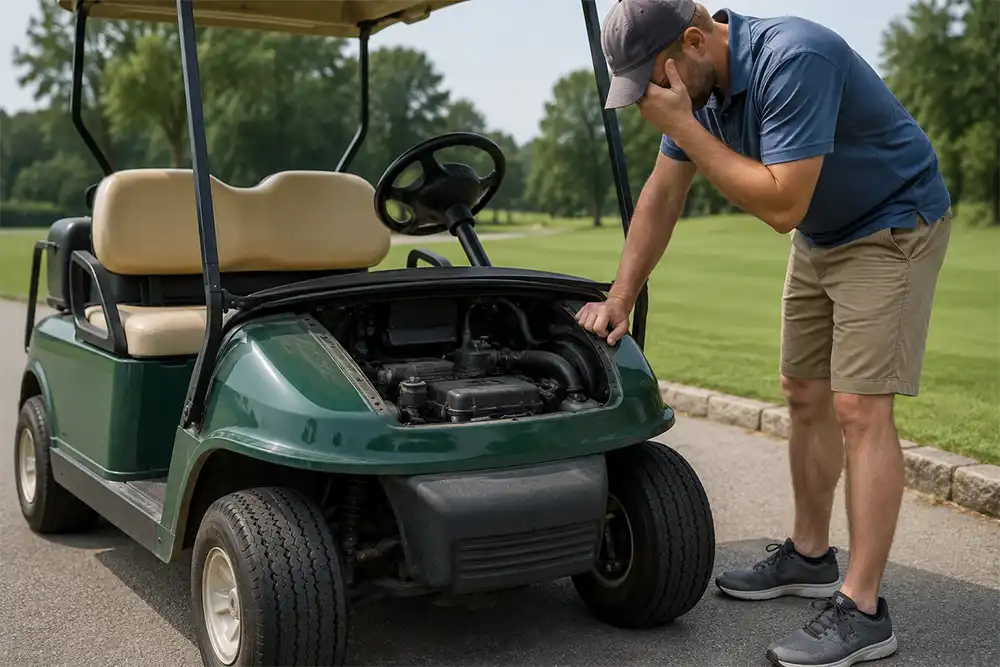
When a gas golf cart starts and dies immediately, think fuel first. The engine needs a steady, clean supply of fuel to keep running. When it starts on the choke circuit and then dies as the choke opens, it means the main fuel circuit isn’t delivering. This points to one of three places.
The fuel filter is the first thing to check. It is inexpensive and easy to replace. A filter clogged with sediment will allow just enough fuel to start the engine but not enough to sustain it. Replace it before anything else if it hasn’t been done in the past year.
The carburetor is the second suspect. Ethanol-blended fuel is hard on carburetors. It leaves varnish deposits in the tiny jets that meter fuel flow. A dirty pilot jet or needle jet will prevent the engine from transitioning off the starting circuit. A thorough carb cleaning or a carburetor replacement fixes this. If you have an EZ-GO TXT gas model, our EZ-GO TXT troubleshooting guide covers fuel system checks specific to that platform.
The fuel pump is the third possibility. Gas golf carts use a vacuum-operated or electric fuel pump to pull fuel from the tank to the carb. A pump that is losing diaphragm integrity will pull enough fuel to start the engine but fail under sustained demand. Testing fuel pump output pressure confirms or rules this out quickly.
Forum Insight
“Fuel delivery failures in gas golf carts are consistently the most misdiagnosed starting problem. Owners replace the ignition coil, plug wires, and spark plugs before anyone checks whether fuel is actually reaching the engine under load.”
Validated across golf cart owner forums including Cartaholics and confirmed by Resort Life Carts technicians. Always confirm fuel delivery before replacing ignition components on a gas cart that starts and dies.
Electric Carts: Sensors, Solenoids, and Voltage
Electric golf carts that start and die right away are usually shutting off as a protection response. Something is telling the controller that conditions are unsafe for continued operation. The three most common triggers are a solenoid fault, a throttle position sensor (TPS) fault, or a battery pack below minimum operating voltage.
Solenoid faults
The solenoid is the large contactor that connects the battery pack to the controller when you press the accelerator. If the solenoid is failing, it may engage briefly and then drop out. You will hear a click when you press the pedal followed by silence or a second click as it drops. A solenoid that is pitting internally from arcing will behave this way. This is a common and straightforward replacement. Our article on a cart where the motor runs but won’t move covers related solenoid and drivetrain diagnosis in detail.
Throttle position sensor faults
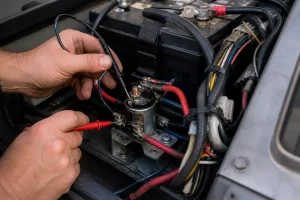
The TPS sends a signal to the controller that represents how far the accelerator pedal is pressed. If the sensor is worn, corroded, or sending a signal outside its expected range, the controller reads it as a fault and cuts power immediately. Testing TPS output voltage with a multimeter while slowly pressing the pedal will show whether the voltage rises smoothly and reaches the expected maximum. A signal that jumps erratically or never reaches full range means the sensor needs replacement.
Low battery pack voltage
A battery pack that has dropped below the controller’s minimum threshold will cause the cart to engage and immediately cut off. The cart “starts” because the solenoid closes and the controller powers on. But once the motor tries to draw current, the pack voltage collapses and the controller shuts down for protection. Resting voltage alone won’t catch this. A proper load test under real driving conditions is needed. Our battery service includes this exact test.
Fixes: What to Do Once You Know the Cause
Gas cart fuel delivery confirmed as the issue
Replace the fuel filter first. It costs almost nothing and eliminates the most common cause immediately. If the cart still dies, clean or replace the carburetor. If fuel delivery from the pump tests below spec, the pump needs replacement. Do not throw ignition parts at a fuel problem. They will not fix it.
Electric cart solenoid confirmed as the issue
Solenoid replacement is a service shop job but not a complex one. Make sure the replacement solenoid matches the voltage rating of your system. A 36-volt solenoid in a 48-volt system will fail quickly.
Electric cart TPS confirmed as the issue
Throttle position sensors are model-specific. Bring the cart’s make, model, and year when ordering the replacement. On most platforms the sensor is accessible and replaceable without pulling the motor or controller.
Battery voltage too low
If the pack cannot hold sufficient voltage under load, repair or replacement is needed before the cart will behave normally. Review our lithium vs. lead-acid comparison if you are weighing a pack upgrade at this point. A lithium pack will not exhibit voltage collapse under startup load the way a degraded lead-acid pack does.
Frequently Asked Questions
Why does my golf cart start and then immediately die?
On a gas cart, the most common cause is fuel not reaching the engine after the initial prime. A clogged fuel filter, a failing fuel pump, or a dirty carburetor can all prevent sustained fuel delivery. On an electric cart, a bad solenoid, a throttle sensor fault, or a battery pack below the minimum operating voltage will cause the cart to engage briefly and then shut off as a protection response.
How do I know if the problem is fuel or electrical?
On a gas cart, if the engine fires, runs for one or two seconds, then dies, that almost always points to a fuel delivery issue. On an electric cart, listen for the solenoid click when you press the pedal. A click with no movement suggests a controller or motor issue. No click at all usually means a solenoid or wiring fault upstream of the controller.
Can a dirty carburetor cause a golf cart to start and die?
Yes. A carburetor with a clogged pilot jet or needle jet will allow the engine to catch on the choke circuit but fail to transition to the main fuel circuit. The result is an engine that starts, runs for a second or two, and then dies as soon as the choke opens. Carburetor cleaning or replacement resolves this in most cases.
What is a throttle position sensor and why does it matter?
The throttle position sensor tells the controller how much power the driver is requesting. On electric golf carts, a faulty sensor can send a signal that reads as a fault condition, causing the controller to cut power immediately after startup as a safety response. Testing sensor output voltage with a multimeter while the pedal is depressed will show whether it is operating within spec.
Cart firing up and dying right away? Schedule a diagnostic with Resort Life Carts in Madera, CA. We handle gas and electric starting faults for all brands. Pickup and delivery available across the Central Valley.