Quick Answer: A golf cart that won’t reach a full charge is most commonly caused by battery imbalance within the pack, a charger stopping the charge cycle early due to a fault, or one or more batteries with dead cells that can’t accept a full charge. Testing each battery individually with a voltmeter after a complete charge cycle is the fastest way to identify imbalanced cells. A charger that clicks off too soon may need recalibration or replacement. Resort Life Carts in Madera, California provides complete battery load testing and charger diagnostics for all major golf cart brands.
If your golf cart charger keeps shutting off before the pack is full, or your cart runs out of power noticeably sooner than it used to, something in the charging system has changed. The challenge with this problem is that the symptom — “not charging fully” — can come from two completely different places: the charger itself or the battery pack. Getting the diagnosis right before spending money on parts is the difference between a $150 fix and an unnecessary $800 battery replacement.
Charger vs. Battery: Understanding Who’s at Fault
Modern golf cart chargers are smarter than they look. They monitor pack voltage in real time and use that reading to decide when the charge is complete. The problem is that the charger has no way to know whether the pack voltage it’s reading represents a genuine full charge or a false ceiling caused by a weak battery resisting the charge. This is why a charger fault and a battery fault can produce almost identical symptoms — the charger stops early either way.
The fastest way to separate the two is a process of elimination. If you have access to a known-good pack, plug your charger into it and watch the full cycle. If the charger completes normally, your charger is fine and the investigation moves to the batteries. If the charger still shuts off too early, the charger is the problem. For most owners without a spare pack to test against, a shop with proper diagnostic equipment is the most efficient path.
Voltage Checks: What the Numbers Tell You
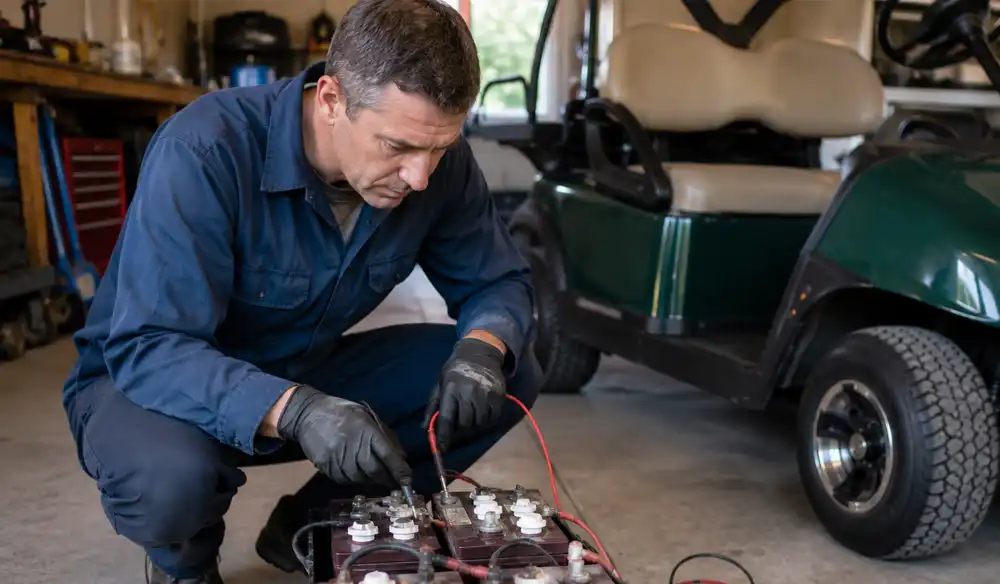
A digital voltmeter is the essential tool here. You should take two readings: one immediately after the charger shuts off (surface charge reading), and another about an hour later (resting voltage). The resting voltage is the number that matters for diagnosis. Here’s what to expect from a healthy, fully charged pack:
| Battery Configuration | Healthy Full-Charge Resting Voltage |
|---|---|
| 36V lead-acid pack | 38.2 – 38.4V |
| 48V lead-acid pack (6 × 8V) | 50.9 – 51.5V |
| 48V lithium pack | 54 – 58V (varies by chemistry) |
| Individual 8V lead-acid battery | 8.5 – 8.9V |
| Individual 6V lead-acid battery | 6.3 – 6.4V |
If your pack total is hitting those numbers but range is still short, the issue is likely capacity loss from age rather than a charge problem — meaning the batteries are accepting a full charge but simply can’t store as much energy as they once did. If individual batteries within the pack are reading significantly lower than the others, you’ve found your imbalanced cells.
“Battery imbalance is the single most common hidden cause of charge problems, one weak cell drags the whole pack down, and the charger shuts off early thinking the job is done.”
Insight corroborated across the Cartaholics battery troubleshooting community and confirmed by our service technicians. A single battery reading 0.3V lower than the rest of the pack after charging is enough to significantly reduce run time and trigger early charger shutoffs.
What Battery Imbalance Actually Means
Golf cart batteries are wired in series, meaning the positive terminal of one battery connects to the negative terminal of the next. When they charge, the charger pushes current through the entire series string. A battery with a dead or weak cell acts like a bottleneck — it accepts less charge, pulls the string voltage down, and causes the charger’s algorithm to terminate the cycle early because the target voltage isn’t being reached cleanly.
The rest of the pack then starts each drive cycle below full charge, which accelerates degradation in those batteries as well. This is why a single failing battery can cascade into whole-pack failure if left unchecked. Catching imbalance early — ideally with individual cell testing — is the key to saving a pack rather than replacing it entirely. Our battery service includes individual cell testing across every battery in the pack, not just a total-pack voltage reading.
Charger Faults: When the Charger Is the Problem
Charger faults are less common than battery issues but should not be overlooked. The most frequent charger problems are a faulty algorithm board that terminates the cycle early, a failed current sensor giving incorrect readings, and corroded or damaged output connections that create resistance in the charge circuit.
Some OBC (on-board computer) chargers on EZGO and other brands can be recalibrated by a technician to account for battery aging. Others, once the control board fails, need full replacement. If your charger is making unusual sounds, running unusually hot, or its indicator lights are showing fault codes, bring both the charger and cart in together for evaluation rather than buying a new charger and hoping that was the issue.
Fixes: Matching the Right Solution to the Right Problem
When the charger is at fault
If diagnostics confirm the charger is shutting off early due to a calibration drift or sensor issue, a qualified technician can often reprogram or recalibrate it. If the charger has internal damage, replacement is the correct path. Always match charger voltage and amperage to your specific battery pack configuration — using a mismatched charger is one of the fastest ways to destroy a battery pack.
When one battery is imbalanced
In a relatively young pack (under three years old) where only one battery is failing, individual replacement can restore balance. The replacement battery must be the same brand, size, and ideally from the same production batch. Mixing batteries of different ages is not recommended and can accelerate imbalance again.
When the whole pack is failing
If multiple batteries are showing low individual voltages or failing load tests, a full pack replacement is the right answer. This is also the moment to evaluate whether a lithium upgrade makes sense. As covered in our guide to lithium vs. lead-acid golf cart batteries, lithium packs charge faster, hold their voltage more consistently under load, and don’t suffer from the kind of cell imbalance that plagues aging lead-acid packs. For anyone planning to keep their cart long-term, the math often favors lithium.
If you’re in the middle of this evaluation and want to understand more about your overall electrical system health, our piece on servicing an electric golf cart walks through what regular maintenance prevents and what warning signs to watch for before charging issues develop.
Frequently Asked Questions
How do I know if my charger or my batteries are the problem?
The clearest test is to plug the charger into a cart with a known-good battery pack. If the charger completes a full cycle normally, the charger is fine and the issue is in your batteries. Testing each battery individually with a voltmeter after charging will reveal which cells are low or refusing to charge.
What voltage should a fully charged 48-volt golf cart read?
A fully charged 48-volt lead-acid pack should read between 50.9 and 51.5 volts at rest, with each 8-volt battery reading around 8.5 to 8.9 volts. If your resting pack voltage is lower than these thresholds, the pack is not reaching full charge.
Can one bad battery prevent the whole pack from charging?
Yes. Batteries in a series pack are charged sequentially, and one battery with a dead or shorted cell pulls the whole pack voltage down. The charger detects that the target voltage isn’t being reached, runs longer trying to compensate, or shuts off early with an error. This is the most common hidden cause of an incomplete charge cycle.
How often should I replace my golf cart batteries?
Quality lead-acid golf cart batteries in a well-maintained pack last 4 to 6 years under normal use. In hotter climates like Central California, heat accelerates degradation and that lifespan can shorten to 3 to 4 years without proper charging habits and storage practices. Lithium batteries typically last 8 to 12 years with much less maintenance.