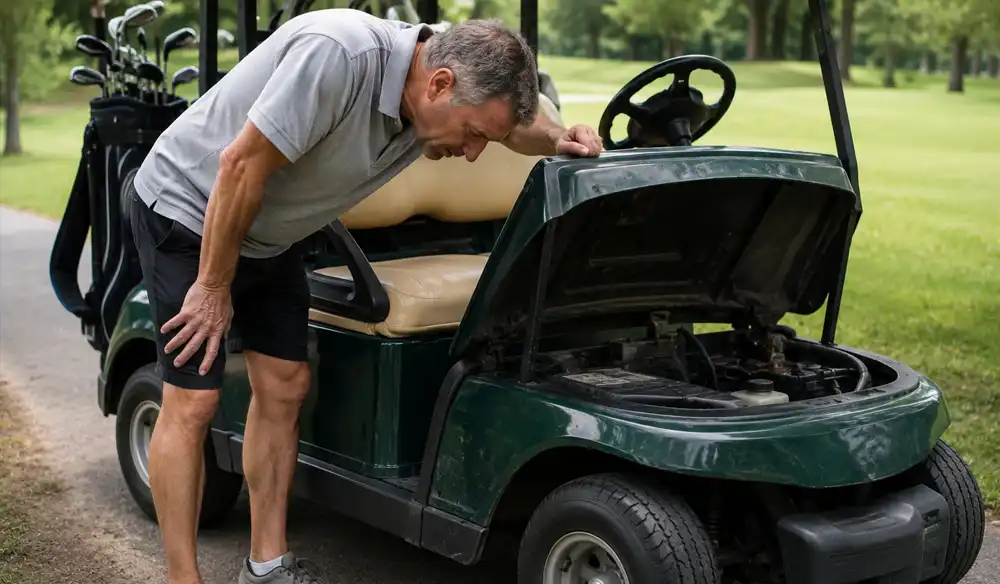
Quick Answer: A golf cart that shuts off after warming up is experiencing a heat-triggered electrical failure, most often in the controller, wiring connections, or battery pack. As operating temperatures rise, controllers enter thermal protection mode, wiring terminals lose contact from expansion, and batteries under sustained load drop voltage below safe thresholds. The cart typically restarts fine once it cools down, that cool-down restart pattern is the clearest diagnostic clue. Resort Life Carts in Madera, California performs full electrical and controller diagnostics for all major brands and can identify whether you need a connection repair, controller replacement, or battery service.
There’s a frustrating pattern that a lot of golf cart owners run into, especially during Central California summers: the cart runs perfectly fine for the first ten or fifteen minutes, then suddenly cuts out. You wait, it cools down, and it starts right back up like nothing happened. Then it happens again. This is not a random glitch, it’s a predictable symptom with a specific set of causes, and understanding them makes the fix straightforward.
Why Heat Is the Real Culprit
Golf carts, both electric and gas-powered, generate significant heat during normal operation. Electric motors, controllers, wiring harnesses, and battery banks all produce heat as current flows through them. When ambient temperatures are already high (which is standard in the Madera area from May through September), those components start closer to their thermal limits before you even turn the key.
The shutdown you experience isn’t the cart “breaking.” In most cases, it’s a protection mechanism doing exactly what it’s designed to do: cutting power before something gets damaged. The problem is that the protection is triggering too early, which means a component is already stressed, degraded, or operating outside its design tolerance.
Controller Issues: The Most Common Cause
The controller is the brain of an electric golf cart. It manages how much current flows from the batteries to the motor, and it has built-in thermal protection to prevent its own circuitry from burning out. On a healthy cart with healthy batteries, this protection almost never activates during normal use. When it starts triggering after 10 to 20 minutes of driving, it’s telling you one of two things: the controller itself is degraded and overheating faster than it should, or the batteries are forcing the controller to work harder than normal to maintain speed and torque.
A failing controller will often show additional symptoms alongside the heat shutdown, sluggish acceleration, hesitation at full throttle, or a clicking or flashing error indicator on carts that have diagnostic displays. If you’re troubleshooting an EZ-GO TXT, our EZ-GO TXT troubleshooting guide covers controller-specific diagnostics for that platform in detail.
Wiring Expansion and Intermittent Disconnects
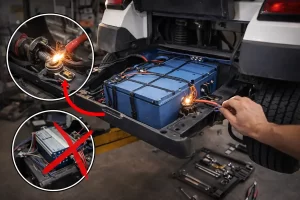
Metal expands as it heats. This is basic physics, but it has real consequences inside a golf cart’s electrical system. Connectors, terminal lugs, and battery cable ends that are slightly loose or slightly corroded at room temperature can lose contact entirely once heat causes the metal to shift. The result is an intermittent disconnect, power cuts out, the cart stops, the connection re-seats as it cools, and everything works again until it heats back up.
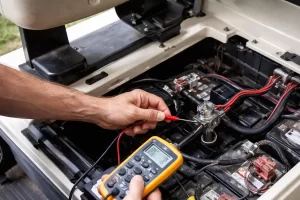
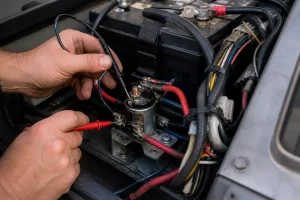
This is one of the most underdiagnosed causes of heat-related shutdowns because the connections look fine when you inspect them cold. Inspecting and cleaning every terminal, checking torque on battery cable connections, and testing for voltage drop across individual connectors under load is the correct diagnostic procedure.
“Heat-related electrical expansion causes intermittent disconnects that are nearly impossible to catch by visual inspection alone, the cart has to be loaded and warm when you check for voltage drop.”
Community insight via Cartaholics Forum thread on heat shutdowns. This matches what our technicians see in the shop regularly — always test hot, not cold.
Battery Load and Voltage Sag
Even if your batteries show a good resting voltage, they may be unable to sustain that voltage under the real load of driving. As a battery pack ages, internal resistance increases. When the controller asks for high current, climbing a grade, accelerating, or running continuously in the heat — the pack voltage sags below the controller’s minimum threshold, and the system shuts down for protection.
This scenario gets worse in summer because battery chemistry is temperature-sensitive. Heat accelerates the discharge rate and increases internal resistance further, so a borderline battery pack that holds up in cooler months may fail repeatedly once temperatures climb. Our battery service includes load testing under real operating conditions to catch this exact failure mode, resting voltage tests alone won’t find it.
If you’re weighing whether to repair or upgrade your pack, our comparison of lithium vs. lead-acid golf cart batteries covers how each chemistry handles heat and sustained load differently, which is directly relevant here.
Fixes: What to Do Based on What You Find
The right fix depends entirely on which component is actually failing. A proper diagnosis before spending money on parts is always the correct first step. That said, here’s how each scenario plays out.
If it’s a wiring or connection issue
All terminals and connectors need to be cleaned with an electrical contact cleaner or a battery terminal brush, properly torqued, and treated with a dielectric grease to prevent future corrosion. Any connector that shows signs of heat damage, melted plastic, discolored metal, or a burned smell, needs to be replaced, not just cleaned.
If it’s a controller issue
Controllers can sometimes be reprogrammed or have specific components replaced by a qualified technician. In many cases, a full controller replacement is the most reliable long-term solution. Attempting to drive on a failing controller risks damaging the motor, which is a significantly more expensive repair.
If it’s a battery issue
Individual weak cells can sometimes be replaced in a lead-acid pack, but if multiple batteries are showing load failure, a full pack replacement is almost always more cost-effective than spot replacements. This is also a strong opportunity to consider a lithium upgrade, which offers better performance in high-heat conditions and a much longer service life.
Frequently Asked Questions
Why does my golf cart stop running after it warms up?
The most common reason is a heat-sensitive controller fault. As the controller reaches operating temperature, it can trigger a thermal protection shutdown. Loose wiring connections that expand with heat, a failing solenoid, or batteries that cannot hold voltage under sustained load are also frequent causes.
How do I know if my golf cart controller is failing from heat?
Signs of a heat-failing controller include the cart dying after 10 to 20 minutes of use, restarting normally after it cools down, and sometimes a clicking or flashing indicator light. A professional load test and controller diagnostic will confirm the issue.
Can I drive my golf cart if it keeps shutting off when hot?
You should avoid driving it until the cause is diagnosed. Repeated thermal shutdowns can permanently damage the controller, wiring harness, or motor windings. Bring it in for a diagnostic before the problem escalates.
Does this problem happen more in summer?
Yes. Ambient heat in Central California summers accelerates the issue because the controller and battery pack are already starting at a higher baseline temperature. Carts that run fine in cooler months often begin shutting down in heat because the thermal threshold is reached faster.