Summary: When a golf cart motor runs but the cart won’t move, the problem is almost never the motor itself — it’s somewhere in the drivetrain. This article walks through how to distinguish a motor problem from a mechanical one, identifies the most common failure points (couplers, axles, and hubs), and provides actionable repair steps. Whether you’re dealing with a stripped coupler on an electric cart or a slipping clutch on a gas model, understanding where the power transfer breaks down is the key to a fast and accurate fix.
You hear the motor humming, the solenoid clicks, the controller shows no faults, yet the cart just sits there. Nothing moves. This particular symptom can be genuinely confusing because it feels like the cart should work, and in one important sense, it does. The motor is doing its job. The problem lives somewhere between the motor’s output shaft and the wheels, and that distinction matters a great deal when it comes to diagnosing the real cause.
Motor vs. Drivetrain: Understanding the Difference
On both electric and gas-powered golf carts, the motor or engine produces rotational force, but that force has to travel through a series of mechanical components before it reaches the wheels. In an electric cart, power flows from the motor through a coupler or spline connection into the differential, then down the axle shafts to the rear wheels. In a gas cart, the engine drives a centrifugal clutch that feeds into a belt-and-pulley CVT system before reaching the rear axle.
When a motor runs and nothing moves, you’re almost always looking at a broken link somewhere in that chain. The motor has no way of knowing that its rotation isn’t going anywhere, it simply spins freely, unloaded, which often makes it sound perfectly normal or even healthier than usual. This free-spinning quality is actually your first diagnostic clue. If the motor sounds smooth and unloaded when it should be pulling the weight of the cart, the mechanical connection downstream has failed.
Coupler Issues
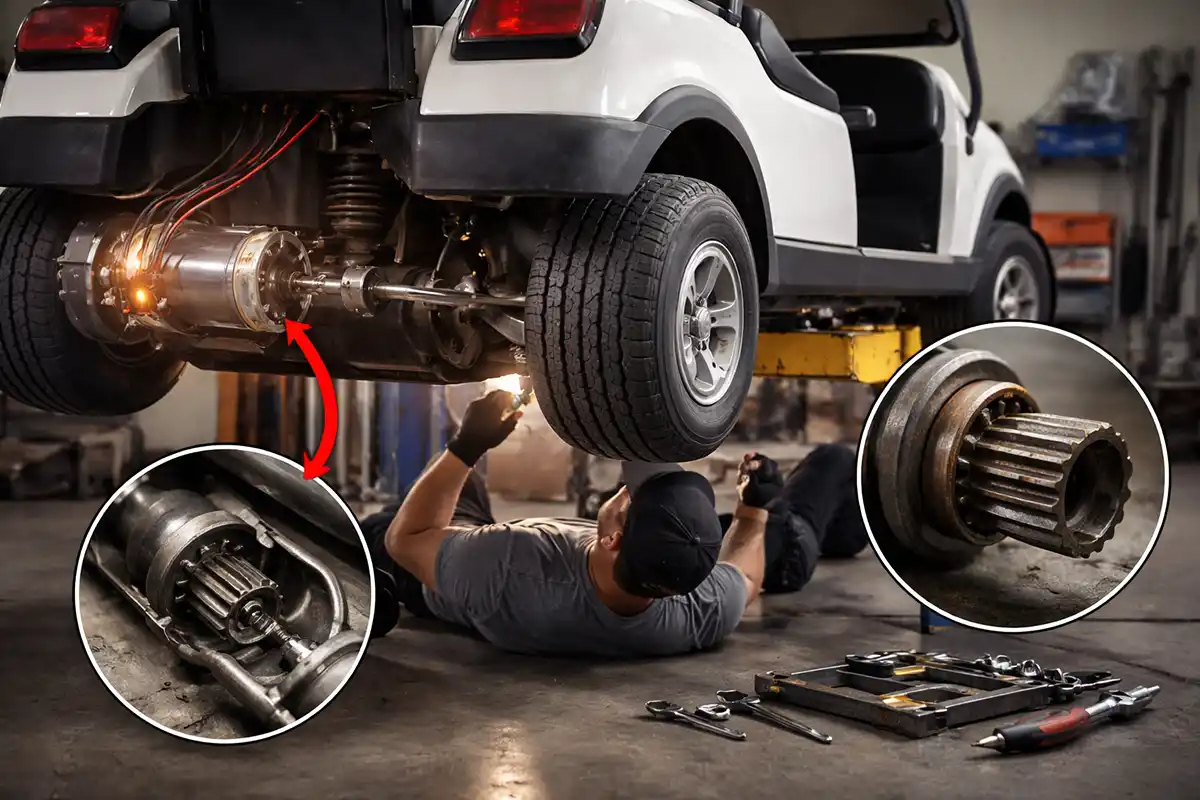
The motor-to-transaxle coupler is one of the most commonly overlooked components in an electric golf cart, and it’s also one of the most frequently responsible for this exact symptom. The coupler is a small nylon or rubber piece that connects the motor’s output shaft to the input of the differential housing. It’s designed with some flex to absorb torque shock, but over time that same flex means it wears, compresses, and eventually strips out entirely.
When the coupler fails, the motor shaft spins freely inside it, turning nothing. The fix is typically inexpensive, a replacement coupler costs between $8 and $25 depending on the cart model, but it requires removing the motor to access it. On EZGO TXT models and Club Car DS carts, the coupler is particularly prone to wear after several years of use, especially if the cart has been run frequently under load on hilly terrain. Inspect the coupler by removing the motor and checking whether the internal splines or teeth are rounded, cracked, or missing entirely.
Forum Insight
“Stripped hubs or couplers are often the culprit. The motor runs fine, but everything just spins — pull the motor and check the coupler first before you go digging into the transaxle.”
Community insight via BuggiesGoneWild forums, thread #162345
Axle Problems
If the coupler checks out, the next place to look is the axle shafts themselves. A golf cart rear axle can fail in several ways: the shaft can shear internally, the splines that connect the shaft to the differential output or to the wheel hub can strip, or the half-shaft on IFS-equipped models can break at a CV joint. In each case, the result is the same — the motor turns the input of the differential, but no motion reaches the wheel.
Diagnosing axle problems often involves jacking up the rear of the cart and observing what spins when the motor runs. If one wheel spins and the other doesn’t, you likely have a stripped or broken axle shaft on the non-spinning side. If neither wheel spins despite confirmed motor operation, the problem may be in the differential itself, a complete coupler failure, or a sheared axle on both sides (uncommon but not impossible in older carts with significant corrosion).
Wheel hub issues are another important variable. The hub is the component that transfers axle rotation to the wheel. Hubs can strip, especially on carts where wheels have been over-torqued or improperly seated over time. A stripped hub will allow the axle to turn freely without actually rotating the wheel — another variation of the same symptom. Removing the wheel and inspecting the hub’s inner splines is straightforward and takes less than fifteen minutes with basic tools.
Fixes and Next Steps
Start by confirming motor operation with a basic load test or by listening for the unloaded free-spin sound described above. From there, systematically work outward from the motor. Check the coupler first — it’s cheap, accessible, and statistically the most common cause of this symptom. If the coupler is intact, jack up the rear and observe axle rotation at each wheel. Then check the hubs. In most cases, you’ll find the failure point before you need to open the differential housing.
For gas carts displaying this symptom, the diagnostic path shifts slightly. A worn or stuck centrifugal clutch will cause the engine to rev freely without engaging the drivetrain, mimicking the same symptom. Check the clutch sheaves for wear and confirm the drive belt is intact and properly seated. A belt that has snapped or slipped off its pulleys will produce exactly this scenario.
Whether you’re doing the work yourself or handing it to a shop, knowing which part of the system has failed means you go in with a clear diagnosis rather than a vague complaint. That alone can save significant time and labor costs.
Golf Cart Solenoid FAQ
The motor is operating correctly, but the mechanical connection between it and the wheels has failed. The most common causes are a worn or stripped coupler, a broken axle shaft, or stripped wheel hubs. Because the motor spins freely with no load, it often sounds and behaves normally even though nothing is moving.
Remove the motor and inspect the coupler directly. A bad coupler will show visibly stripped, rounded, or missing teeth or splines. If the nylon is cracked or compressed flat, it needs replacement. On many EZGO and Club Car models, a bad coupler is identifiable without special tools.
No. A failed coupler means no drive power reaches the wheels, so the cart won’t move at all. Even if the coupler is partially intact, driving on it risks damaging the motor shaft or differential input, which are significantly more expensive repairs.
A stripped hub means the wheel itself is no longer gripping the axle shaft — the shaft turns but the wheel doesn’t. A broken axle means the shaft itself has snapped or cracked internally. Both produce the same no-movement symptom, but a broken axle typically shows play or looseness in the axle shaft when checked by hand.
Yes, though the failure points differ. On a gas cart, a worn centrifugal clutch or a snapped/slipped drive belt will cause the engine to run without moving the cart. The diagnostic approach is similar — work outward from the engine through the drivetrain until you find where rotation stops being transferred.
The part itself typically runs between $8 and $25. If you’re doing the repair yourself, budget about an hour of labor. Shop rates vary, but since coupler replacement is a straightforward job on most EZGO and Club Car models, professional labor shouldn’t add more than one to two hours of shop time.
Resort Life Carts Golf Cart Service Center
- 10740 CA-41, Madera, CA 93636
- (559) 831-1971 (ext 104)