Summary: Converting a golf cart from flooded lead acid batteries to lithium is one of the most impactful upgrades an owner can make, but it is also one of the most commonly mishandled. This article covers the real benefits and risks of lithium conversion, the wiring mistakes that kill controllers and solenoids, how to assess whether your existing controller is compatible with a lithium battery management system, and the practical fixes that get conversions done right the first time. Whether you are mid-conversion or troubleshooting a failed one, understanding the electrical demands of lithium chemistry is essential.
Lithium battery conversions have become one of the most talked-about upgrades in the golf cart world, and for good reason. The performance benefits are real and meaningful. But the number of carts that end up back in the shop after a botched conversion is just as real, and the damage caused by common wiring errors can be expensive enough to offset every advantage the new batteries would have delivered. Getting the conversion right requires more than dropping in a new battery pack. It requires understanding how lithium chemistry behaves differently from lead acid and what that difference means for every other electrical component in the system.
Benefits vs. Risks
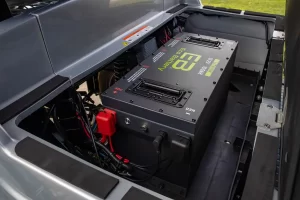
The case for lithium is strong. A quality lithium iron phosphate (LiFePO4) pack delivers more usable capacity from the same rated amp hours, maintains voltage under load far more consistently than lead acid, weighs significantly less, and lasts anywhere from two to five times longer before needing replacement. A 48-volt lithium pack that weighs 60 pounds can replace a bank of six 8-volt flooded batteries weighing close to 300 pounds, with better range and virtually no maintenance overhead.
The risks, however, are equally real. Lithium batteries do not behave the same way as lead acid during charging and discharging. They rely on an integrated battery management system (BMS) to regulate cell voltage, control charge cutoff, and protect against thermal events. That BMS communicates with the rest of the electrical system in ways that flooded batteries never did, and when the surrounding components are not matched to those communication signals, failures follow. The three most common failure categories are wiring errors, charger incompatibility, and controller mismatch, and they often compound one another.
Wiring Mistakes
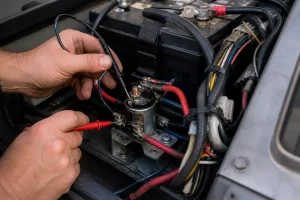
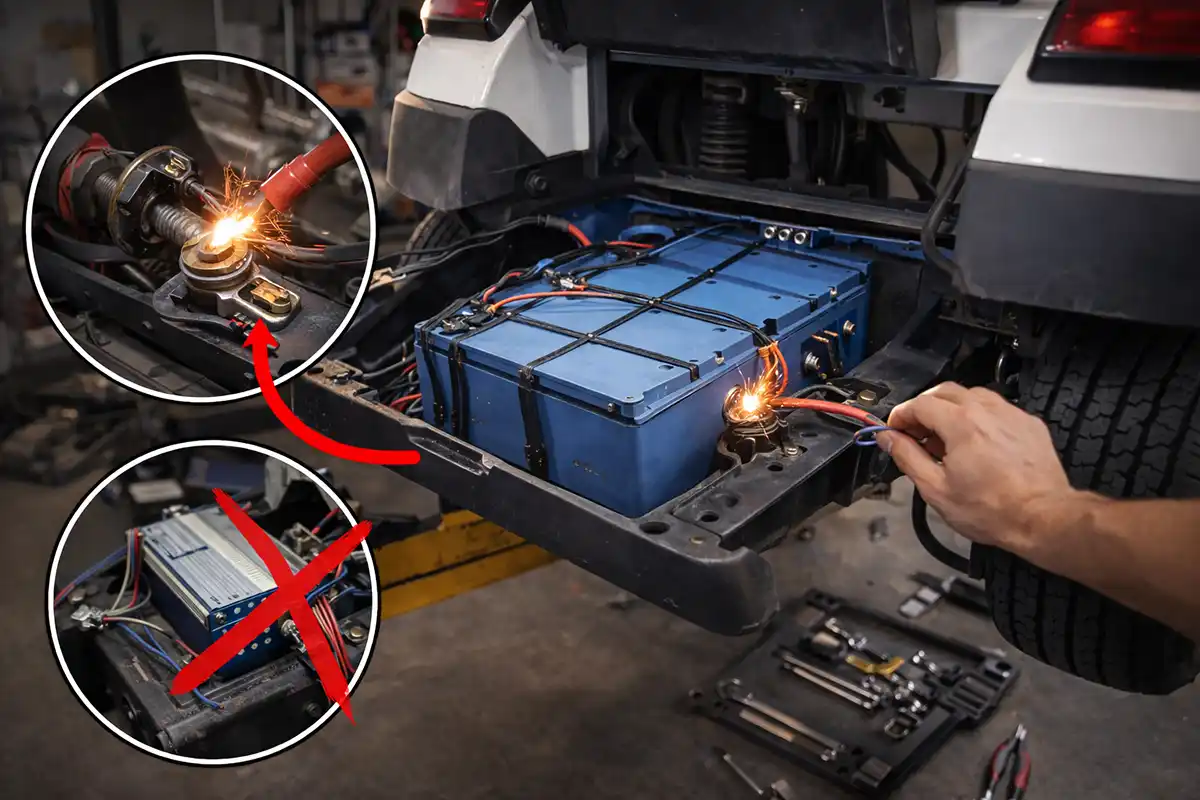
Improper wiring is the single most common cause of conversion damage, and it tends to be expensive when it goes wrong. The most frequent error involves grounding. Lithium battery packs with an integrated BMS use the negative terminal as a managed ground, meaning the BMS may interrupt that ground circuit as a protective measure. If the cart’s solenoid, controller, or accessory wiring is tied into the battery negative in a way that bypasses or conflicts with BMS ground management, the result can be voltage spikes, ground loops, or uncontrolled current that damages the controller or burns the solenoid contacts.
A second common wiring error involves the charge circuit. Many owners attempt to retain their existing tow switch or charge receptacle wiring without accounting for the higher charge voltage and different charge profile that lithium requires. Connecting a lead acid charger to a lithium pack will at minimum fail to charge correctly and at worst trigger a BMS fault that shuts the system down entirely. At the other extreme, a lithium charger connected to a pack without proper wire gauge for the increased current capacity can cause heat buildup in the wiring harness itself.
Terminal torque is another overlooked detail. Lithium packs often use different terminal styles than the side or top post terminals found on flooded batteries, and using the wrong connector hardware, or failing to torque connections to spec, introduces resistance that creates heat under load. Even a moderately loose connection on a lithium pack can produce enough heat cycling to degrade the terminal and eventually cause an intermittent fault that is extremely difficult to trace.
Forum Insight
“Improper wiring is killing solenoids and controllers left and right on these conversions. Before you power anything up, map every ground path and make sure the BMS ground is not being bypassed anywhere in the harness.”
Community insight via Cartaholics
Controller Compatibility
The motor controller is where lithium conversions most often hit an invisible wall. Older controllers, particularly those found in pre-2010 EZGO, Club Car, and Yamaha models, were designed around the voltage curve of flooded lead acid batteries. Lead acid packs sag significantly under load and rise significantly at full charge. A 48-volt lead acid pack may read 51 or 52 volts fully charged and drop to 44 or 45 volts under hard acceleration. Lithium packs are far flatter. A 48-volt LiFePO4 pack may sit at 54 volts fully charged and hold 52 volts under the same load that would pull a lead acid pack down to 44.
Many older controllers interpret that sustained higher voltage as an overvoltage fault and shut down, or they simply were not designed to handle the sustained input and fail over time. Before purchasing a lithium pack, confirm that your controller’s operating voltage range is compatible with the fully charged voltage of the specific lithium pack you are considering. This information is available in the controller’s technical documentation, and most reputable lithium pack manufacturers publish a compatibility guide. If your controller is not compatible, budget for a replacement controller as part of the conversion cost. Attempting to run an incompatible controller will eventually produce the same result as a wiring fault: a damaged or failed unit that costs more to replace than the controller upgrade would have.
Reprogrammable controllers like the Alltrax or Curtis programmable units offer the most flexibility for lithium conversions because voltage thresholds and current limits can be adjusted via software to match the lithium pack’s actual operating range.
Fixes and Conversion Best Practices
Start with documentation. Before removing a single battery, photograph or diagram your existing wiring, noting every ground connection, every accessory tap, and the routing of the charge circuit. A reference diagram costs nothing and prevents a significant number of reinstallation errors. Confirm controller compatibility before purchasing the lithium pack. Source a lithium-compatible charger at the same time as the pack, not afterward. Use appropriately gauged wiring for the full current capacity of the new pack, torque all terminals to manufacturer spec, and verify that no ground paths in the harness bypass the BMS.
Once the conversion is complete, perform a full charge cycle before operating the cart under load. Monitor for any BMS fault codes using a compatible Bluetooth app or display if the pack supports it. If the cart throws a controller fault immediately after conversion, the most likely cause is the voltage mismatch described above, and resolving it requires either reprogramming the controller or replacing it with a compatible unit.
Lithium Golf Cart Conversion Problems FAQ
In almost all cases, no. Lead acid chargers use a charge algorithm that is not compatible with lithium chemistry. Using a lead acid charger on a lithium pack will either fail to fully charge the batteries or trigger a BMS fault. A lithium-specific charger matched to your pack voltage is a required part of any conversion.
Most controller failures after a lithium conversion are caused by one of two things: a wiring error that introduced a voltage spike or ground fault, or sustained overvoltage from a lithium pack whose fully charged voltage exceeds the controller’s rated input range. Older OEM controllers are particularly vulnerable to the second cause.
A battery management system is an integrated circuit within the lithium pack that monitors individual cell voltages, regulates charge and discharge, and cuts off power when it detects a fault condition. It is what makes lithium batteries safe and long-lived, but it also means the pack actively communicates with the rest of the electrical system in ways that require compatible components.
A DIY conversion is entirely possible for someone comfortable with basic electrical work, but it requires careful preparation. Documenting existing wiring, confirming controller compatibility, sourcing the correct charger, and following proper torque specs for terminals are all steps that require attention to detail. Skipping any of them is where conversions go wrong.
LiFePO4 chemistry is the universally recommended option for golf cart conversions due to its thermal stability, long cycle life, and safe discharge behavior. Brands like Epoch, Dakota Lithium, and Allied Lithium are well-regarded in the community, but the most important factors are matching the pack voltage to your system and confirming BMS compatibility with your controller.
Resort Life Carts Golf Cart Service Center
- 10740 CA-41, Madera, CA 93636
- (559) 831-1971 (ext 104)